
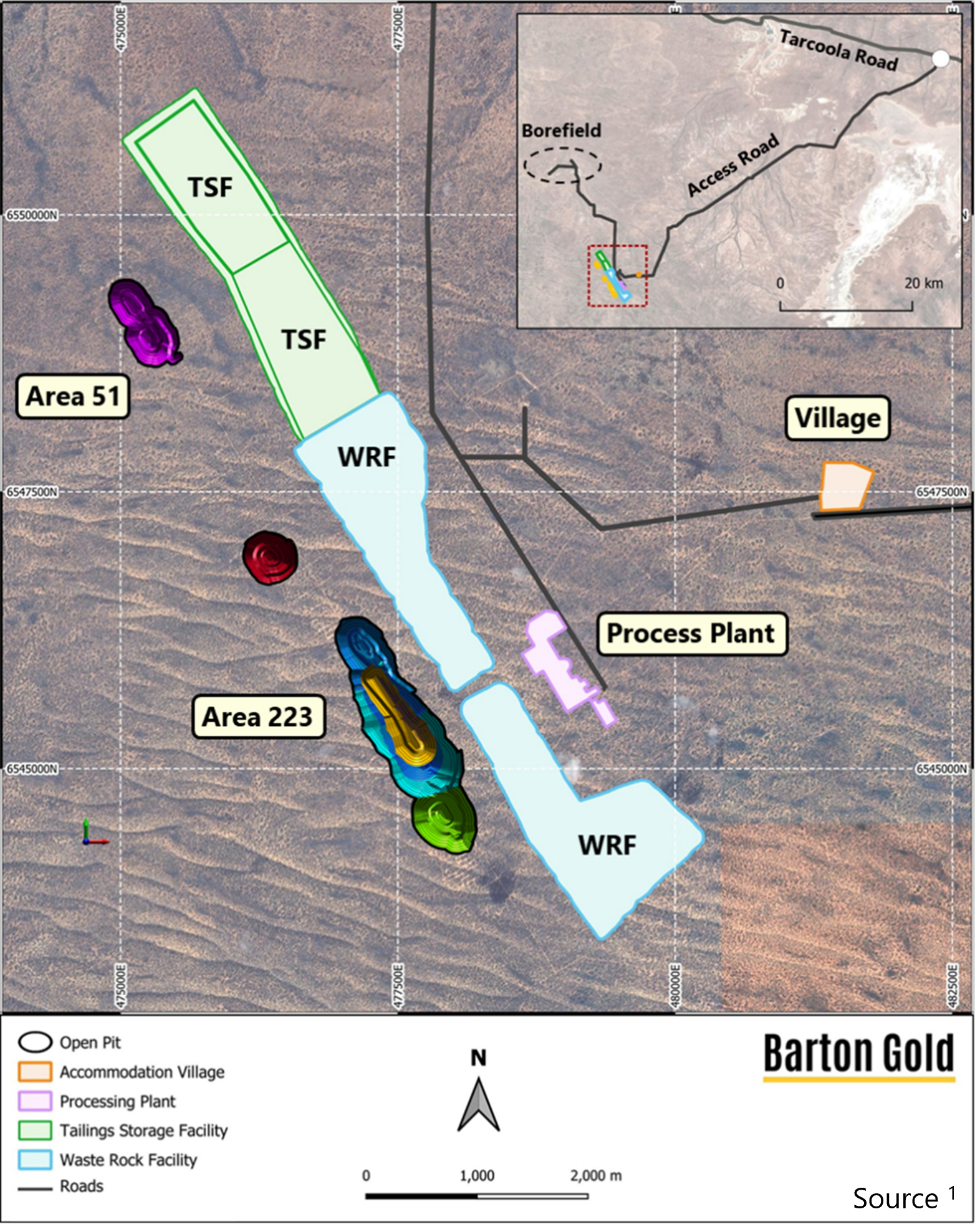
Tunkillia is located ~70km S/SE of Tarcoola, and is the site of Barton’s planned future ‘Stage 2’ growth project incorporating large-scale bulk open pit operations, a new high-efficiency bulk processing gold mill, and supporting infrastructure including a large village, airstrip and power.
The project hosts more than 30km strike extent of the highly prospective Yerda and Yarlbrinda Shear Zones which are several kilometres wide and analogous to major Kalgoorlie Shear Zone systems. The project area has seen very little exploration outside of the current Mineral Resources area.
Tunkillia hosts current JORC Mineral Resources of ~1.6Moz gold and ~3.1Moz silver across three main deposits, with the majority of mineralisation contained in the main ‘Area 223’ deposit.* Barton has grown the project by ~1Moz since acquisition, for an all-in cost of less than A$20 / oz Au.
Barton published an Optimised Scoping Study (OSS) during May 2025 demonstrating a robust project development model driven by efficiencies of scale in capital and operating costs, and a high-grade central ‘Starter’ pit which accelerates project development payback to less than 1 year.
Development drilling and other programs are underway, targeting JORC Mineral Resource upgrades, completion of a high-quality pre-feasibility study (PFS), and the submission of a Mining Lease application by the end of 2026.
* See full JORC (2012) Mineral Resources Estimate here
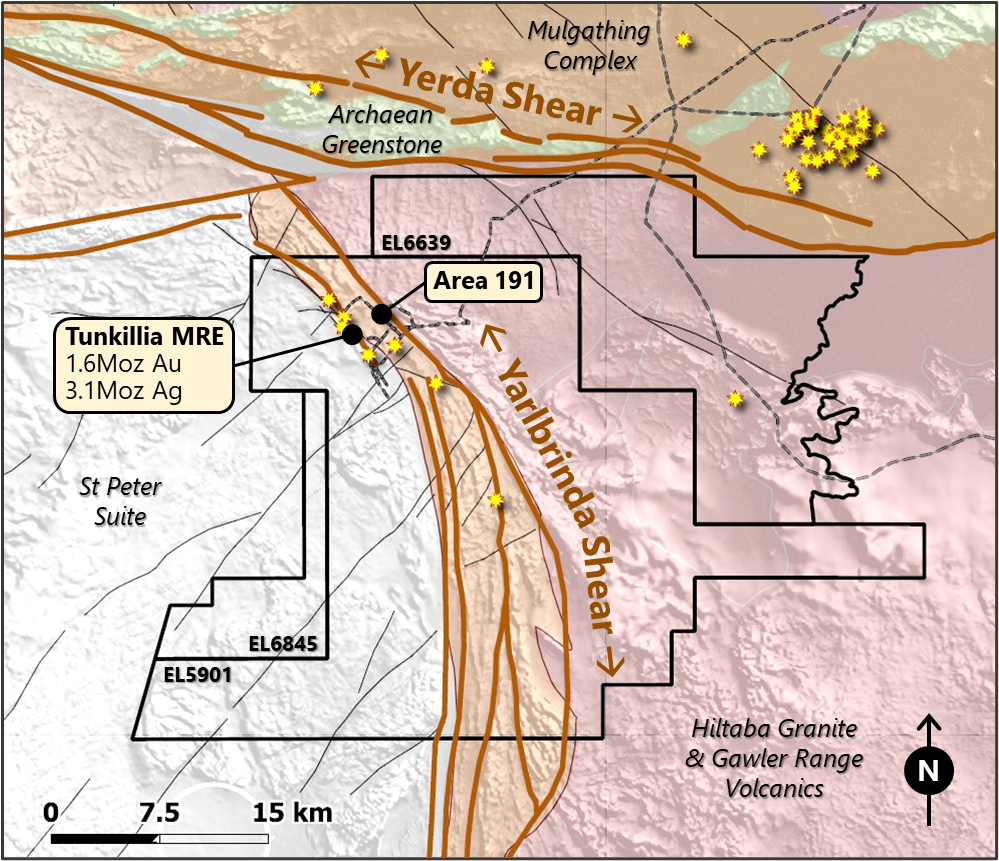
Tunkillia Project with Yerda and Yarlbrinda Shear Zones
Optimised Scoping Study (OSS)
The May 2025 OSS validated Barton’s thesis for a and attractive project development driven by efficiencies of scale, simple metallurgy and a ‘Starter’ pit which drives a rapid payback schedule. Key outcomes include (all unlevered):
- A$399 million up-front capital cost, including mining pre-strip
- 5Mtpa bulk open pit mine & standard gravity + CIL mill
- ~120,000oz annual gold production
- ~250,000oz annual silver production
- A$2,222/oz Au All-In-Sustaining Cost (AISC)
- A$4.8 billion Life of Mine revenue
- A$2.7 billion Life of Mine operating cash flow
- A$1.4 billion Net Present Value (7.5%)
- 73% equity Internal Rate of Return (IRR); and
- 0.8 year payback period
These figures assume open pit optimisation based upon A$3,500/oz of gold, and revenue figures based on A$5,000/oz gold and A$50/oz silver. The results demonstrate an attractive, large-scale project with an AISC below Australian and global averages, and material upside to current metals prices.
These figures are in particular enhanced by Resource geometry driving rapid development payback.
Rapid Payback
The May 2025 OSS validated Barton’s thesis for an attractive development project, with a very fast payback period driven by efficiencies of scale, simple metallurgy and attractive Resource geometry.
A higher-grade zone central to the main Area 223 deposit contains broad, 80 – 100 metre wide mineralisation suitable to high-efficiency bulk open pit mining, but also contains a ~300m long zone containing higher-grade mineralisation shallow in the deposit and near the footwall.
This mineralisation is modelled by the OSS to be the first produced, and forms the highest value portion of the ‘S1’ or ‘Starter’ pit. The effect of the higher-grade mineralisation is that the average modelled feed grade from the S1 pit is 1.19 g/t Au, roughly 45% higher than the Life of Mine grade.
The ‘S1’ pit is modelled to yield ~206,000oz gold and ~490,000oz silver during the first ~13 months at a cash cost of A$997/oz gold produced. Assuming gold and silver prices of A$5,000/oz and A$50/oz (respectively), ‘S1’ is modelled to yield A$825 million operating profit, repaying development 2x over.
‘S1’ and ‘S2’ together are modelled to yield ~365,000oz gold and ~923,000oz silver during the first ~27 months. Assuming gold and silver prices of A$5,000/oz and A$50/oz (respectively), ‘S1’ and ‘S2’ together are modelled to yield A$1.3 billion operating profit, repaying development 3x over.
Over 50,000 metres of development drilling programs are underway at Tunkillia, targeting Mineral Resource upgrades, the conversion of the OSS to a high-quality PFS, a Mining Lease application.
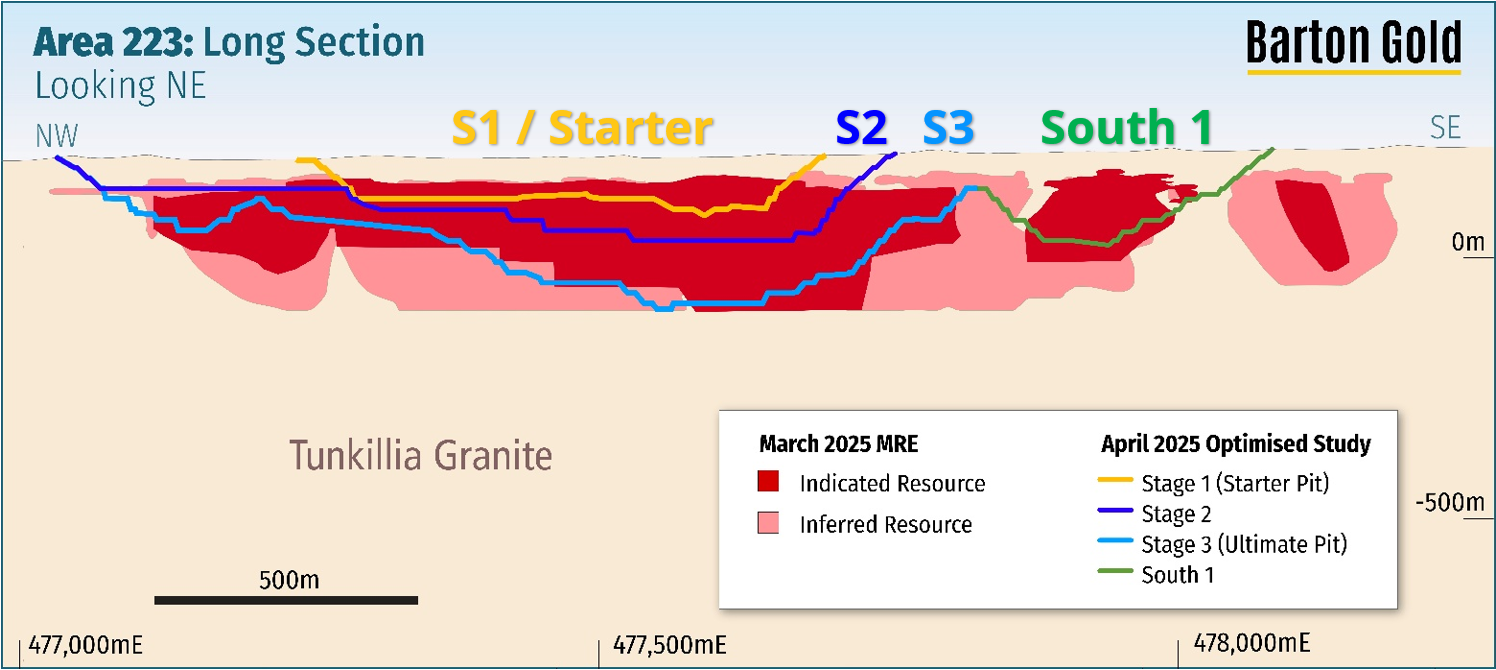
Tunkillia Area 223 long section
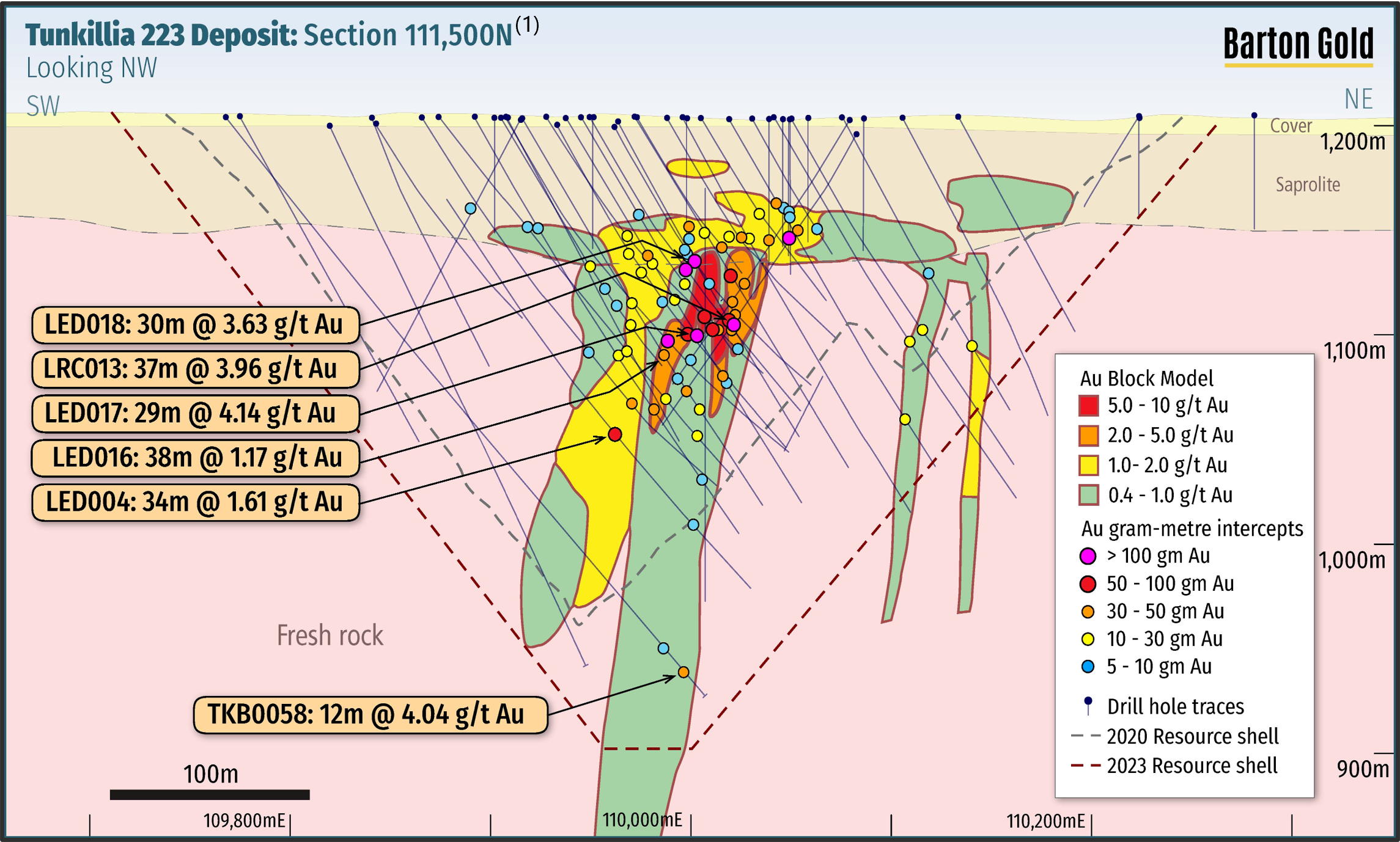
Tunkillia cross section 111,500N, looking northwest
Untapped District Scale Potential
Historical exploration at any scale has generally been limited to only a small northern portion of the Yarlbrinda Shear in the vicinity of the 223 Deposit. Numerous southern prospects have been identified by previous explorers, but the majority of the shear zone has not received any modern or systematic exploration.
The Company has identified initial regional targets of interest and will undertake additional geophysical analyses to general a combined structural, geophysical and geological model and refine priority drilling targets. In particular, Barton will target regional analogues to the 223 Deposit area, as well as areas containing changes in shear orientation and intersecting regional structures along the western and eastern demagnetised zones.

Tunkillia Regional Targets Along Yarlbrinda Shear Zone